
 Local Government Explained
Improving public services: In conversation with Nillumbik Shire Council CEO Carl Cowie

David Burroughs, LGIU Associate
In this interview, Carl Cowie, CEO of Nillumbik Shire Council in Victoria, Australia, shares insights from his career to date. Emphasising the importance of treating residents as shareholders in the council and offering them the best possible service.

In this interview, Carl Cowie, CEO of Nillumbik Shire Council in Victoria, Australia, shares insights from his career to date. Emphasising the importance of treating residents as shareholders in the council and offering them the best possible service.
Carl Cowie didn’t begin his career in the public sector. But the shift from working in the private sector financial services has proved effective, with customer satisfaction at Nillumbik Shire Council at a 15 year high.
Originally from Scotland, Carl moved to Australia in 1996 and has lived there ever since, apart from an 18-month period working in Doha where he supported the opening of Al Ahi Private Hospital as COO.
He was previously general manager of Caulfield Hospital and was finance director of Grove Group helping build the athletes village for the 2006 Commonwealth Games. From running a transport company for private equity, he then joined Spotless Group as General Manager – Business & Industry Managed Services in 2011.
His switch to the public sector came in 2014, when he was considering three different roles, including two in facilities maintenance for listed companies in Perth and Queensland. “I didn’t particularly want to uproot my family at the time,” he says.
Instead, a former colleague told him about the opening for the CEO position at Mornington Peninsula Shire Council. “The brief was around a significant organisational transformation,” he says. The council was looking to take more of a private-sector approach, which piqued Carl’s interest and prompted him to apply for the role.
After four successful years at Mornington Peninsula Shire Council, he moved to become CEO of Nillumbik Shire Council in 2018. Adapting to working in the local government sector took around six months, he says. “The Council were quite forgiving at the start, particularly because I was used to reporting to boards where they set the direction, and the CEO then has the responsibility to get on and deliver that. So there were a few times I followed the private sector approach, only to find out that certain decisions were meant to be decided by the council!”
Council work
Councillor Terms in Victoria run for four years, with the next election due on 26 October. The council then develops a four-year council plan, which runs into the first year of the next council term.
Carl says “pretty much everything” in the current council plan has been achieved, including the opening on 2 September of Nillumbik’s first dedicated youth hub. The facility was developed in conjunction with Nillumbik’s Youth Council, a formal advisory group consisting of 15 young people aged 15-25.
“The youth council have been really terrific, and they’re taking a lot of responsibility for what this youth hub is and how it will help young people,” Carl says.
Source: Nillumbik Shire Council
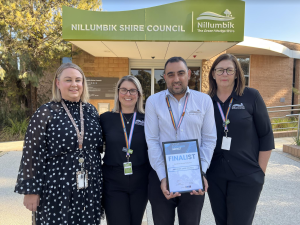
The Customer Service Benchmarking Australia (CSBA) Mystery Shopping Program ranked Nillumbik Shire Council as the “best in local government sector” across Australia – with the council’s customer experience team and a customer-first strategy key in achieving this.
Carl says that at both Mornington Peninsula Shire Council and Nillumbik Shire Council, he has tried to align the values of the organisation to serving the community, often referring to the residents and rate payers as the council’s shareholders.
“Whilst we’re not growing a share price for them, they are entitled to the best possible service that we can give them,” he says. “I’m really, really strong about that. Serving people to the best of our ability, for me, is the fundamental part of what local government is here to do.”
Among these values that Nillumbik holds, including respect, integrity, community, adaptability, and collaboration, Carl says collaboration is particularly important when dealing with customer enquiries.
“That’s one of the areas where we’ve had such a positive result in dealing with any customer inquiries, because you can’t solve everything at the customer service counter,” he says. “Local government is so broad, you can’t expect everyone to have all the answers to all the possible questions.”
The council has also adopted four customer-first commitments, to be empathetic, consistent, effective and simple. “We don’t bamboozle anyone with local governments speak, and we ask them at the end of a call ‘has that answered your question, is there anything else that can help you with?’,” Carl says.
Building the team
Building the right team has been central to achieving this level of customer satisfaction, and Carl says the position descriptions for each job role across the organisation include the values of the organisation. “If you don’t buy into that, we’re not the right place for you,” he says.
Carl also encourages all staff to identify and report issues, even if it is outside of their job role. “It may not be your job to fix it, but if you’ve seen it, it’s your job to let us know,” Carl says. “There’s 450 of us, we’re all part of it.”
He also encourages staff to suggest ideas and try new things without being afraid of making mistakes. “Don’t be super happy if you’ve made a mistake but don’t worry about it, just don’t make it again,” he says. “Some attempts at improvement will work, some won’t, but never stop trying, and that’s part of continuous improvement.”
Using the data
Carl encourages other councils looking to improve their customer service to use their data, particularly around complaints, which can provide opportunities to improve. “Collect and don’t be ashamed if it’s bad, that’s your opportunity to improve for the community” Carl says. “Nobody starts at say 8 out of 10. You start somewhere, and then you try and keep improving, but it needs a focus. You have to put time and effort in.”
This sometimes leads to identifying particular teams who may be underperforming, which can then lead to difficult conversations. “You do it as nicely as you can and hope that people get with the programme but you need to ensure people understand your message!” Carl states. “And largely, that’s what’s happened at Nillumbik because the values we stand for mean that I’d better pick that phone up and see if the people at the front counter need me. We have an 80% first contact resolution which is, I think, about as good as it can get… we’ll try for more though!”
The team have also worked to understand issues from the customer’s perspective, which has led to a reduction in outstanding requests over the last two years from 400 to 10.
“Someone out there is waiting to hear from us about a query, that could be really impacting their life,” he says. “So when you explain to people, what if this was your family member? How would you like it? It encourages our whole team to understand the importance of solving problems for people. Following a full business system transformation, over the last two and a half years, the council is now also using AI to help process all incoming mail, and a group is exploring other potential benefits of introducing AI while ensuring it is used in a secure manner. “We’ve done the big picture systems transformation, and now we’re really looking at service provision, at the granular level” he says.

Source: Nillumbik Shire Council
Challenges
Nillumbik is known as the “Green Wedge Shire” due to the rural conservation zone that covers 91% of its total area. While the community enjoys the lack of development, Carl says this means that income from rates remains steady instead of growing. This in turn makes it more difficult to respond to the financial pressures caused by cost increases and the expectation of service improvements.
“We have a significant financial challenge to do everything and to bring on new services,” Carl says. “That’s the sort of thing that keeps me awake, but there are opportunities and we’re looking at those through enhanced partnerships with the private sector.”
Outsourcing has already proved successful in some areas such as leisure facilities and waste collection.
Carl says Nillumbik Council is also very environmentally aware and is attempting to be at the forefront of climate adaptation and mitigation, which presents further partnership opportunities.
This includes through Edendale Community Environment Farm, where there are plans to create a facility Nillumbik Environment and Climate Action Hub (NECAH) where the community can learn how to make their homes more efficient while also learning about climate adaptation and mitigation.
The council has already worked with the Wurundjeri Woi Wurrung Cultural Heritage Aboriginal Corporation to improve the health of waterways around the farm. This has led to the return of duckbilled platypus, which have now begun breeding in the creek.
Having loved seeing otters in the wild while fly salmon fishing in the Scottish Highlands, Carl says he has enjoyed seeing the wildlife in Australia. “My new otter is the duck-billed platypus,” he says.
Was this article helpful or relevant for you?


