
 Local Government Explained
Learning from outstanding work in Ireland: report on the NOAC Good Practice in Local Government Seminar

Sid Hayward
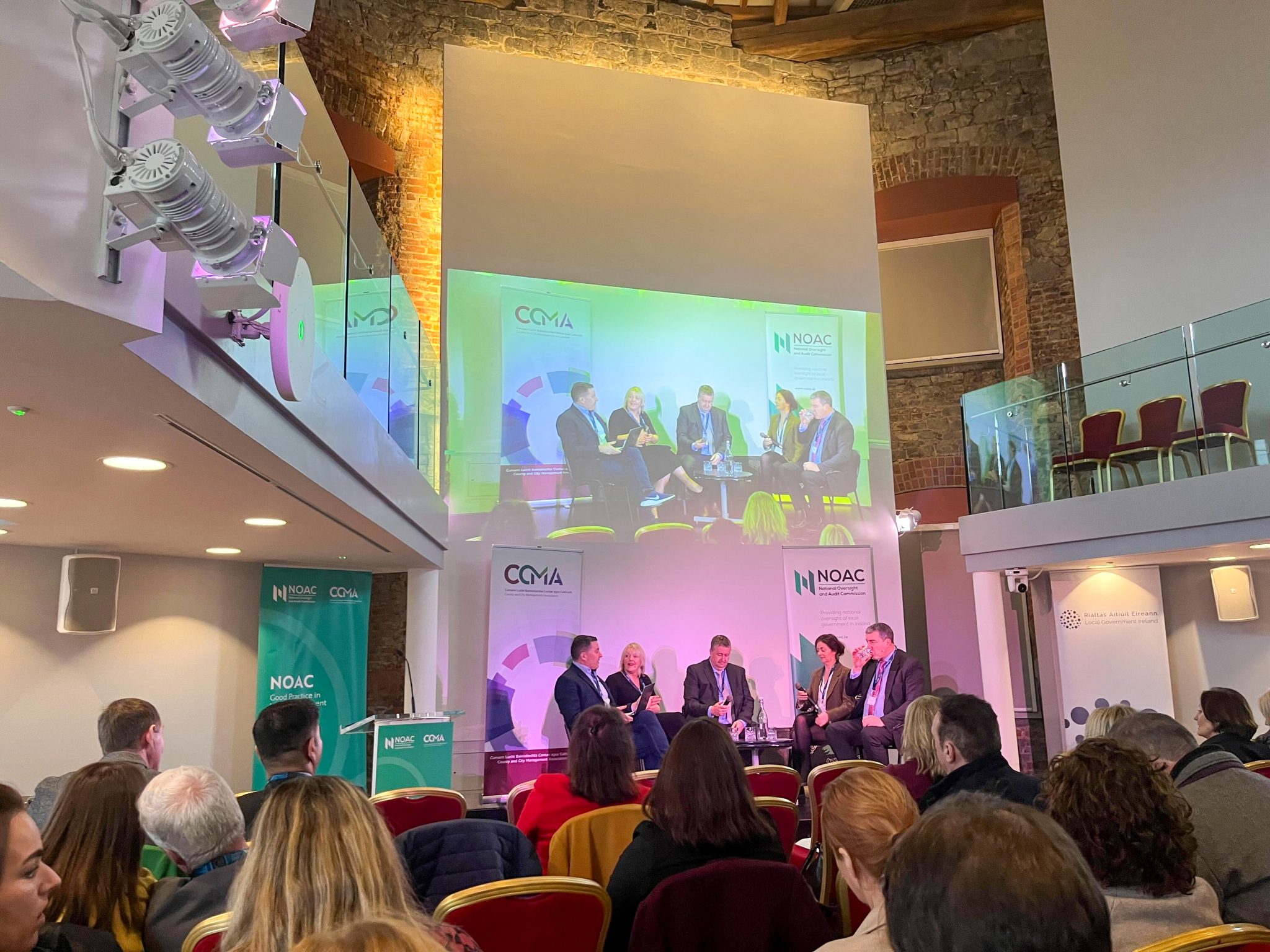
NOAC’s seventh annual Good Practice in Local Government seminar was a chance to hear what Irish local authorities are doing for the people they serve, and to see responses and insights to policy in real time. This article will explore the key takeaways from the event and what some of the wider issues and challenges speakers and attendees think are influencing the sector in 2025.
Introduction
In February, I attended the seventh annual Good Practice in Local Government seminar, organised by the National Oversight and Audit Commission (NOAC). The event, held in Kilkenny Castle, Kilkenny, showcased six outstanding local government projects from Ireland, and brought together chief executives and senior local government professionals from across the country to a space solely dedicated to council innovation. It was a chance to hear what Irish local authorities are doing for the people they serve, and to see responses and insights to policy in real time. The event highlighted the variety of services local government in Ireland provides. Two of the initiatives we have covered in more detail on our website through case studies supplied by the councils themselves, read more here and here.
It’s worth noting that for every initiative covered at the seminar, no purchase order had to be raised or new staff hired – instead, each case study is an example of innovation in a relatively restricted sector, with comparatively fewer resources than other local government systems overseas. This article will explore the key takeaways from the event and what some of the wider issues and challenges speakers and attendees think are influencing the sector in 2025.
Context
Established in 2014 under the Local Government Reform Act, NOAC is an independent oversight body for the local government sector in Ireland. Its oversight function measures every council’s performance across 45 Performance Indicators. Its scrutiny, performance and validation processes not only work to highlight areas where improvements are needed in local authorities, but also highlight best practice across a wide variety of departments, policy areas and projects.
Efficiency
The thread that linked the initiatives above all else was a focus on improving efficiency. Each presentation stressed that the policy they were detailing either directly looked to improve team efficiency, or was a more efficient model compared to the previous way of doing things.
Perhaps the most obvious example of this came from Donegal County Council, who presented on their adoption of Lean methodology in a time of internal digitisation. We heard that by 2030, 90% of relevant council services will likely be delivered digitally to the people of Donegal, who they say are increasingly digitally savvy and want to access services 24/7. In recent years, the council’s digital budget has increased by 60% and the number of digital applications the council received has risen by 240%, all while the digitalisation unit received just one increase in personnel.
To address this, the council’s Local Enterprise Office engaged in a pilot Lean initiative to drive internal efficiencies. The initiative looked to advance digital transformation and process improvement in how the council delivers front-facing public services. Lean methodologies, widely used in the private sector, emphasise the elimination of waste while optimising processes in an effort to deliver maximum value to customers. The Local Enterprise Office adopted Lean tools and techniques to review its internal processes in an effort to improve operations and innovation within the organisation. The council reported the trial was a success in improving service delivery and internal efficiency, with the LEO having now moved to a paperless office as of this year. It has digitalised all of its processes, including grant applications and payments, sped up response times, all while increasing productivity. Because of this, grant payment times have been reduced by 33% and grant decision times have been reduced by 50%. Lean has provided, the council says, a framework for a culture of customer-focused, continuous improvement, while also ensuring staff have more time for work that is more interesting to them day-to-day.
Another scheme with clear benefits to efficiency was Kildare County Council’s GeoCollect scheme, which the council have covered in more detail on the LGIU website. GeoCollect is an innovative solution that integrates multiple complex datasets and geospatial data into a format that provides total capture of commercial activity. GeoCollect can identify and refer to any property where a business is based but no rates are being collected.
Geocollect can also tell if someone in a commercial building is leaving and being replaced. Essentially, it means that everyone who should be getting a rates bill, gets a rates bill.
Before the council launched GeoCollect, they relied on revenue collectors. While these collectors have a good knowledge of the local area, they can’t see everything from the roadside, and relying on them doesn’t capture changes in occupation. Inspections were ad-hoc, with no guarantee of a productive outcome. Plus, the system brought with it issues of travel expenses and carbon footprint.
GeoCollect, however, allows for the maximisation of commercial rates income without any additional spend or hire. As a data visualisation tool stemming from multiple sources, it negates the need for staff to require multiple databases when creating individual customer accounts, acting instead as a ‘one-stop shop’ for commercial rates. The council reported that the ease of access to the data, combined with its quality and depth, has transformed how commercial rates administration is delivered in the local area, while bringing with it additional commercial rates income. The council estimates a 12% increase in the number of properties in its ratebook, representing a monetary increase of approximately €1.5m. It also ensures commercial rates staff can provide a full picture of commercial activity without the need for inspection, supporting the council’s transition from community-based commercial rates collection to an office-oriented one. We heard that a council could develop this within existing resources, with it only taking up the developer’s time and staff’s time, and it being embedded within systems the council was already paying for. The scheme was shortlisted at the 2023 Public Sector Digital Transformation Awards.
Disaster response and primary information
Storm Darragh was still fresh in the minds of the attendees and presenters at the seminar. As a consequence of the storm, councils were clearly more aware of their role as the first source of contact for information. This mindset influenced case studies that at first glance were seemingly unconnected.
Take Meath County Council’s local election live stream initiative, for instance. During the local elections of June 2024, the council took the groundbreaking approach to livestream its counting process. The council was seeking to address numerous communications challenges:
- Ensuring that all 220,000 County Meath citizens could access real-time information about election proceedings, regardless of whether they could make it to the count centre
- Addressing the fast-paced nature of news dissemination in the world of social media, to ensure the council were the primary source of information for the public and that that information was timely and accurate
- Educating the public about the electoral process, as the vast majority of citizens are effectively left out of the essential democratic process each time.
The council devised a virtual livestream platform for the event, allowing all citizens the ability to watch the count in real-time or to replay the event later. The Council developed chat functionalities for the stream and social media promotion to boost engagement and broader public electoral discourse. The livestream successfully ran from June 9th to the 11th on the Council’s YouTube channel and in turn across social and local media embeds. The Council believes the scheme positioned them as the primary source of information while helping to create a more inclusive, accessible electoral process for those who would otherwise face barriers, while boosting electoral transparency and community dialogue. They also underlined the environmental benefits and the high level of digital engagement they received, including more than 28,000 views on the stream.
Elsewhere, Clare County Council presented their Tree Survey scheme, which seeks to improve transparency and position the council as the primary source of information in both normal and emergency situations. The scheme is a digital tree databank that helps the council better manage its urban tree coverage. The scheme saw the Council establish a tree survey project team, responsible for delivering a digital survey solution to enhance proactive and reactive tree management. It sees surveyors in the field use a tablet to record GPS coordinates, species, descriptions, dimensions, condition, age and photographs into an interactive app. These inputs automatically generate a risk rating, while necessary works can also be inputted alongside a timeframe. The Council stressed this digitising of tree management has brought numerous benefits, such as reduced risk of tree failure during storms, enhanced decision-making and operational efficiency, and providing detailed, consistent maintenance records. It also acts as a good reasoning tool for public inquiry into why a particular tree was cut down.
The Council’s pre-existing method was paper-based, with a lack of complete records, leading to difficulty in identifying individual trees, a system they described as very inefficient and time-consuming. Now, Clare County Council’s tree surveyors can record a tree in the field in 6 or 7 minutes with minimal training needed, with the risk rating system featured in the app reportedly making the tender process much easier, as it instantly flags the trees affected or at risk in projects and applications. The council also added that the technology is transferable to other authorities via the Build to Share Model under the National Digital Strategy.
Regenerating sustainably
In presentations and discussions, the speakers repeatedly highlighted the rapid pace of change and the importance of digitising services. Dublin City Council’s Adaptive Reuse Unit (ARU) highlights how councils can revamp their local areas sustainably and in keeping with modern demands. The ARU is an innovation unit for new approaches to social housing development via the acquisition of vacant commercial properties. Commercial vacancy and part-vacancy levels are as high as 29% in some areas of Dublin, with 4,000 vacant or partially vacant properties across the council area. This scheme provides an opportunity for the city to reimagine itself. The climate action project specifically focuses on the development of a vacant office building in a designated decarbonisation zone. Not only does it involve converting office buildings to apartments, but in keeping with the circular economy approach, the fittings and fixtures will be reused where possible. In the scheme, the Council moved to create 15 one-bed units across three floors, at a total cost per apartment of 422,000 Euro, with development funded via the Social Housing Investment Programme. During construction, the building will also act as a community hub for the council’s climate action promotion and support. The initiative acts as a way to meet housing need without the additional costs of providing new infrastructure while ensuring development is low-carbon, with best practice redevelopment producing 70% less carbon when reusing a building than developing a new one. Ultimately, the Council say, it’s about making these buildings more central to the community in which they are located.
Community-led innovation
Finally, Cork County Council detailed their My Creative Wish scheme. Every local authority in Ireland is responsible for curating activities to celebrate Cruinniú na nÓg; Ireland’s national day for celebrating youth creativity under the Creative Ireland Programme, an initiative aiming to improve Irish culture and creativity.
This year, Cork County Council embraced a child-centred approach via My Creative Wish, its own youth consultation. By better understanding the creative aspirations of young people, the Council hoped to better unlock the social benefits of the arts. The Council aimed to deliver on several of its strategic aims, from improving the social capital and quality of life of communities and the marginalised, building healthier happier communities, and celebrating diversity and cultures. What’s more, the Council underlined that these are the voters of the future, so building that relationship and trust early with local governments is crucial.
The scheme saw some 700 submissions from children from across 36 schools, requesting what hobby or creative outlet they would like to pursue, with submissions ranging from songwriting and animation, to ceramics and circus skills. Of these, 17 winning submissions were selected. Those selected took part in a series of six-week workshops offering hands-on learning opportunities led by professional creative practitioners across diverse creative fields. Thirteen runners-up were awarded tickets to taster workshops at local libraries.
Because of this child-led approach to shaping the activities and experiences they wanted, the Council reported a 450% increase in participation compared to previous years, while better reflecting the interests and creative passions of the participants. The Council also reported anecdotal evidence from education facilitators and parents among young people who, in the past, had been hard to reach, again breaking down barriers to participation. They wished to underline the impact of including young people in the planning and delivery of creative and cultural initiatives. Customer is key, they argued, and this customer approach also extends to kids.
Comment
Over 30,000 people work in the Irish local government sector, and local councils provide over 1,100 services, many on behalf of multiple government departments. The above initiatives represent just a glimpse of the range of services all 31 councils provide. In the closing remarks, the speakers agreed that the message for people to take away from the seminar was that no matter what the idea or project is, to just go for it. While creating a culture of change may present its own challenges, finding solutions is empowering. Likewise, mistakes happen, but in local government, we should keep focusing on outcomes and good practice. The speakers were also keenly aware of the speed of change, noting that it’s impossible to say where we’ll be in a decade’s time tech-wise, having gone from the filing cabinet to landlines to limited internet access to where we are today. With that in mind, committing to a culture of innovation to stay on top of an ever-changing world is vital.
Was this article helpful or relevant for you?


