Local Government Explained
Interview with Cllr Katie Pragnell, East Renfrewshire Council

Caitlin Lord and Sid Hayward, LGIU
In this interview, we spoke to Cllr Katie Pragnell of East Renfrewshire Council about her experience as a councillor. Cllr Pragnell was elected in 2022 and last year, she was named Young Councillor of the Year at our LGIU and CCLA Cllr Awards ceremony in Scotland.
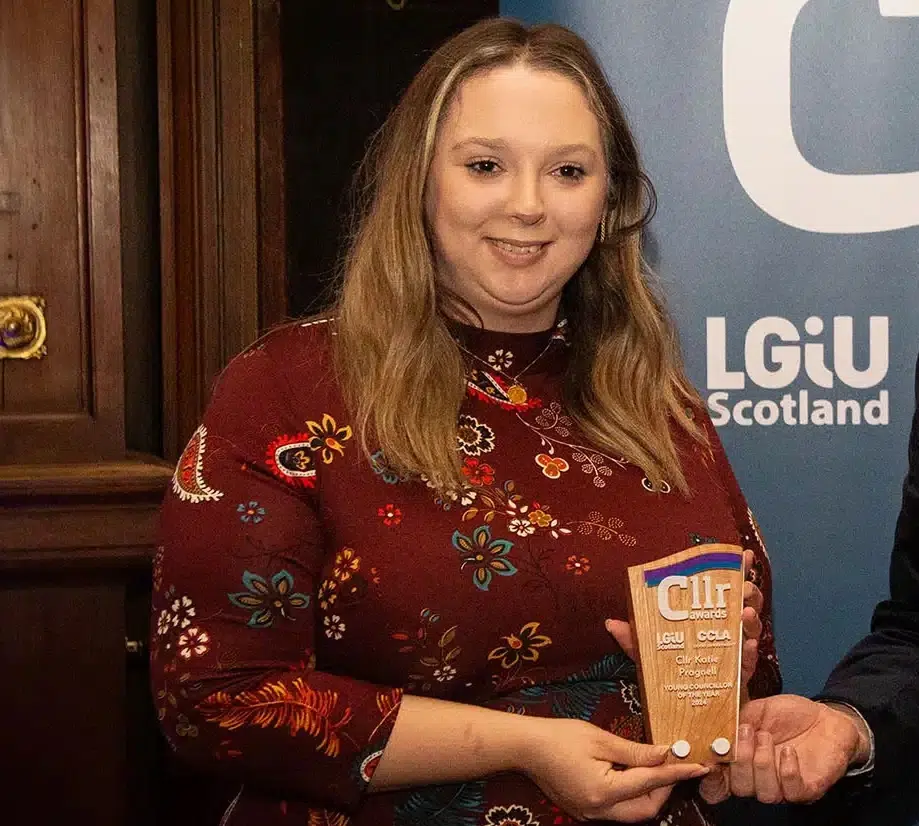
In this interview, we spoke to Cllr Katie Pragnell of East Renfrewshire Council about her experience as a councillor. Cllr Pragnell was elected in 2022 and has since worked with East Renfrewshire Council’s Education Department, notably the Learn Well service, to ensure that young people who find engaging with school challenging are supported. Cllr Pragnell is also chair of East Renfrewshire’s Integration Joint Board and has oversight of the work of the Health and Social Care Partnership. As someone living with a disability, Katie has a keen interest in promoting disability rights and inclusion. Last year, she was named Young Councillor of the Year at our LGIU and CCLA Cllr Awards ceremony in Scotland.
Watch the full conversation on Youtube here.
00:00 Introduction to Cllr Katie Pragnell
02:04 Inspiration behind becoming a councillor
03:38 Achievements and community impact
05:38 Personal experience shaping public service
08:27 Communication and transparency in local government
10:06 Advice for young aspiring leaders
13:03 Future aspirations and legacy
15:08 Recognition and personal reflections
A written version of the interview has been edited down into a Q&A format, which you can read below.
This interview has been edited for clarity and conciseness.
What inspired you to become a councillor?
I got into politics by accident, after struggling to access education and healthcare. I was encouraged to join a political party by my modern studies teacher. And to be honest, I was determined to make sure that no one else experiences the challenges I faced; I wanted to try and influence decision-making in the hope of making a difference and creating change. Also, I love East Renfrewshire, and when the opportunity arose to stand in the ward I grew up and spent my life in, I jumped at that. Community is really important to me and my family has lived in East Renfrewshire for five generations, so community ties run deep in my family and it was just a great opportunity. I was very proud to have the support of the community and to get elected.
What achievement are you most proud of so far in your time as a councillor?
I think there are quite a few! One of the things I’m really proud of is supporting our local community groups. In particular, I’ve done a lot of work with Netherlee and Stamperland Community Council. I’ve supported them in accessing funding for the Netherlee and Stamperland Walkway to improve its accessibility and make it a safe walking route to the local primary school.
I’ve also supported their vision to create a pump track in the local park, which will provide cycling, scootering, and any wheeling activity opportunities. They saw the need for something for facilities for all ages, and I’ve worked with them, council officers, and councillors to bring their vision to life. Recently, the council approved funding for this project and became an official partner. So that was such an achievement and it was really community-driven. I feel I played my part in trying to convince council officers and councillors that this was a good idea. And it just shows you what communities can do with a bit of support.
Also, simple things like increasing accessible parking spaces in our villages and town centres. It’s something I’ve always struggled with and I had many emails when I was first elected from people who wanted to use our local businesses, but couldn’t access them because there was very little disabled parking. This has had a huge impact and it impacts those who need these spaces, but also allows them to actually engage with our community and support our local businesses.
Finally, I’m a very proud corporate parent and take great pride in the work I’ve done with our care-experienced young people. I feel very privileged to be part of their lives and for them to have embraced me in such a way. Each time I meet with them, I’m in awe of what they’re doing and how they’re working with the council to improve the lives of other care-experienced young people, whether that’s actually doing housing or education.
Can you tell us about how your personal experience has shaped your approach to public service and policy?
Well, I wouldn’t be in this role if it wasn’t for my lived experience, and it’s at the core of everything I do. And I think no matter what I do in the council, it’s always there, and I think everyone knows that. So I think it creates my passion, and it drives me. I think it’s no secret that it’s a difficult time for local government across Scotland and across the UK, with really difficult decisions being made on a daily basis. And it can be easy to make these decisions without really understanding the real human impact, and as someone who’s had to access these services, I really understand that. So I’m determined that if these difficult decisions have to be made, that equality impact assessments aren’t just a tick box exercise. They’re crucial to any policy making within the council and particularly within the integration joint board and the Learn Well service.
I think residents understand the really difficult challenges local government face, but we have to take the community with them. So I think it’s really important that it’s a journey we all work together and we have to be open and transparent so that when these difficult decisions are made, if they’re well-versed in why these things have to unfortunately happen, then it does make things slightly easier when decisions are made. And I think when you look at issues over quality, especially when it comes social care, it has been extremely difficult. But I think people do realise that if you find them help and alternatives and you bring them on that journey, it’s easier.
Our Learn Well service is the only model of its kind that’s found in Scotland. It’s a truly multidisciplinary approach with young people at the centre of it. So it brings together teachers, educational psychology, support workers, mental health workers. And I’m determined to do all I can to help it succeed. Recently, they’ve now moved into their own premises instead of being in council-run premises, as we’ve converted one of the old janitor accommodations at a local primary school. So they’re now at the heart of the community. And to be quite honest, if this service had been about when I was at school, it would have been life-changing for me. I know that, having spoken to parents, carers and the young people themselves, it truly is. Without this service, which is still only a couple of years old, their children would have completely disengaged from education and all its kinds. So it really is a lifeline. And I’m just very determined to help in any way to make it to this lead and I have to say the team have been incredible at embracing me and understanding why I take such a keen interest.
What changes would you like to see in how councils work with communities to provide more inclusive and effective services?
I still think there can be an issue with communication and transparency. Sometimes, councils just take it for granted that we all speak ‘councilspeak’ and we all kind of know what’s going on. However, when members of the public see services getting cut or not operating as they used to, it’s so apparent that communication is central to everything we do, whether that’s online or actually via face-to-face consultations and trying to spread the word about why these things are particularly difficult but I just think it’s key to everything we do and I think in East Renfrewshire for sure we’ve kind of been ahead of the curve on this and we were the first local authority in Scotland to embrace social media way back in 2008, which was pretty ground breaking.
And as such, our following has kind of grown over the years, but there’s always room for improvement. I recognise even there was a best value report produced by Audit Scotland on the strength of sharing the last couple of months, and it did actually appraise the communication. But I just think there’s no room for complacency, and we always have to strive to improve. And we have to listen to communities in whatever way we can, and yes sometimes that will be very difficult, but we need to understand that communities and councils can operate the way they need to and want to.
What advice would you give to a young person who wants to pursue a leadership role or a public service role?
I would encourage them to definitely go for it. No matter what your political views are, I think our council chambers need to be more representative of our population. So in each room, we need to ensure we have a large population of young people.
And it can be difficult in local government, especially as a young person, you will feel quite a lot of impostor syndrome. But it’s incredibly important that you do stand if you want to. A bit of advice I always get for young people looking to stand, I can guarantee you that even if they don’t perhaps share the same political views as you, young councillors will be supportive and encourage you and offer words of wisdom because we’re all in this together. No matter our views, I think healthy democracy needs young people as it needs people from all walks of life. So I can guarantee you that no matter what your political stance is. If there is a young person sitting in that council chamber, they will support you. And so feel free to reach out to them because certainly I’ve had many conversations with young people in the last couple of years who are considering standing for local government next time round. And it’s just so important that we do this together. And to be quite honest, I think it can be easy to stay in your political silos, whether you’re independent or as part of a political party, but I have been overwhelmed with the support I’ve received, cross-party support, over the last couple of years. And I wouldn’t be where I am today without friendships that have been made from that. And a lot of it is young people supporting each other, all in the same boat.
Having diverse elected representatives is so important, so it’s great that you’ve been able to foster and be part of that network and help to build that diversity.
In East Renfrewshire, there are only two councillors under 30. My colleague and I are in different political parties, but we understand the challenges, and I know we’ve always tried to look out for each other whilst we serve our time because it can be difficult. I would also say if you want to embark on local government or any sort of public service, make sure you have a great support network of friends and family, because they’re the people you rely on when things don’t always work out.
What are your hopes for the future? What role do you see local government and councillors playing in the next 25 years? And what legacy would you like to leave?
The political sphere changes daily, even sometimes hourly. So, I never want to take being in politics for granted. I know times of change when it is not a guaranteed job for life, and we can never take people for granted. But I hope I will still be able to foster trust amongst my community.
I would hope one day perhaps to be in the Scottish Parliament representing the community. I love it at a Scottish level because, certainly, being in local government there has sometimes been a bit of frustration, and there are things that you can’t change at the local level that you can at the Scottish level. So I’d hope to maybe be there one day, but you should never take things for granted and never take the public for granted, because we’ve seen where that can lead.
If politics didn’t work out for me, in my role as health and social care convener and as chair of the integration joint board, I’ve opened up my eyes to the world of social work. I do have plans if politics does not work out to go into the social work profession. I wouldn’t have realised that if I hadn’t been in this role. And I think that’s really important and profound impact that having my role has had on me that if politics doesn’t work out. I’m determined to serve the public in whatever way I can.
Yes, it’s true public service. Finally, what did it mean to you personally and professionally to be named LGIU and CCLA’s Young Councillor of the Year last year?
It meant a lot to be quite honest. I was honoured to even have been nominated and then shortlisted, as it was such a tough category with so many amazing other young councillors in Scotland. I was quite shocked and it was great to be there with my parents and my partner. I think there was a nice sense of pride because they’ve seen me kind of go through this journey and there’s been times where I’ve wondered if it’s worth it, asking “am I doing the right thing?” But to kind of be recognised in this way was truly special, and it was a really special night. To share that with my family and also to Cllr Owen O’Donnell, the council leader who had nominated me and also my fellow colleague, Cllr Betty Cunningham, who subsequently won an award as well. It was just a fantastic event and night and it’s something I’ll always remember. And I was quite overwhelmed in the aftermath of, again, the messages and emails of support from people across the political spectrum that recognised and said it was well deserved.
Nominations for our 2025 LGIU and CCLA Council Awards are still open. They close on the 11th of June. So if you know a councillor doing an amazing job, then nominate them for these national awards. Find out more here, where you will discover information about the Cllr Award categories, previous winners like Cllr Pragnell and how to nominate a councillor.
Was this article helpful or relevant for you?